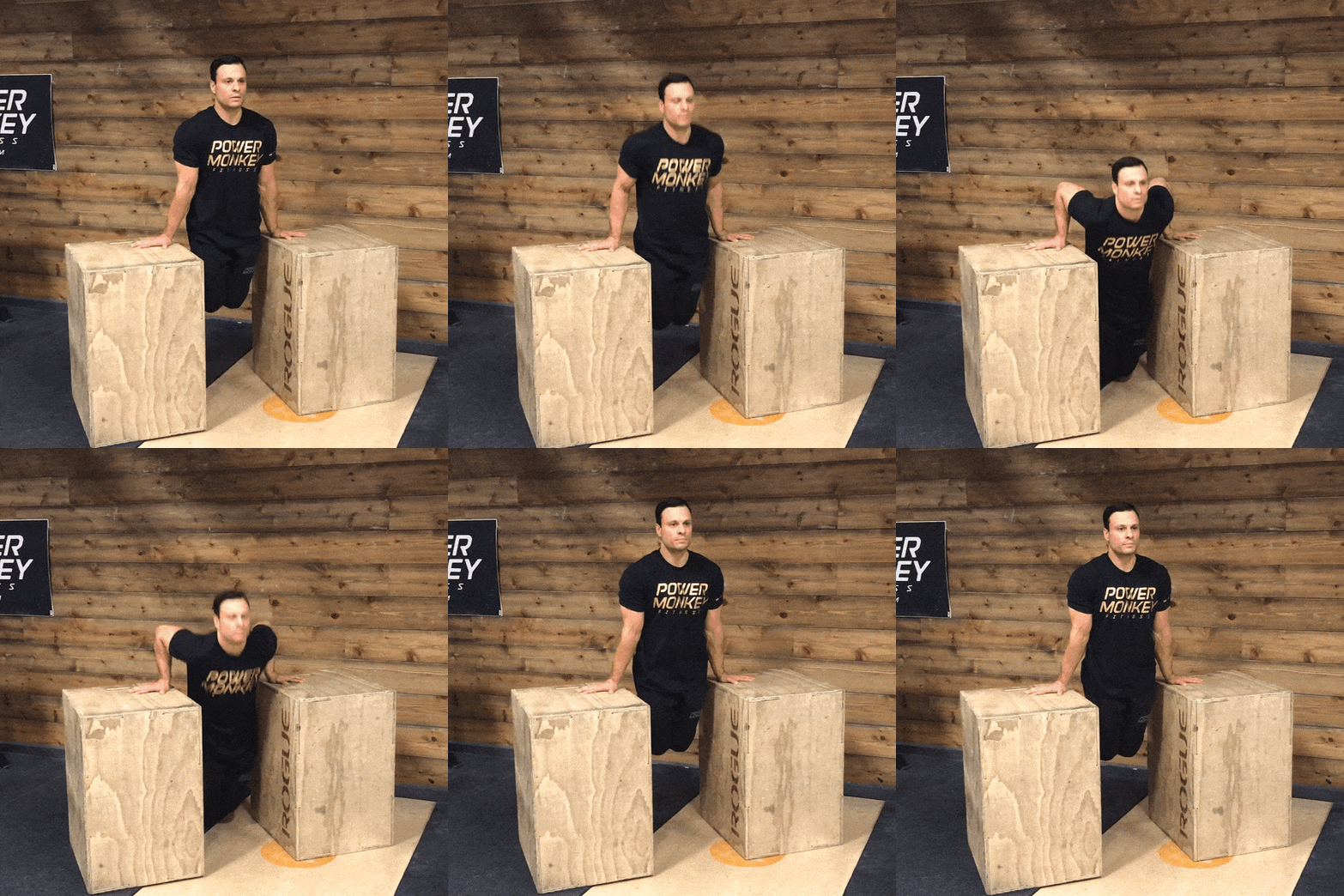
16May2020: With gyms in short supply the spotlight is on home workouts like never before. Body weight only routines can be complete, balanced, challenging, and functional. Sadly, workouts like the Men’s Health “Big Weekend Workout…450-Rep Challenge” are none of the above.

Warning: Do Not Try This At Home!
Range of Motion: Remember, the shoulder is the most mobile, least stable joint in the human body. A passive shoulder stretch with elbows way behind the back is a recipe for disaster. This motion puts the glenohumeral joint into hyperextension–well outside of the average person’s active range of motion. This makes impingement very likely, whether you feel pain right away or not. Over years, this move can wreak havoc.
Worst of all, the fix couldn’t be easier: use two boxes, benches, or sturdy chairs on either side of your body and face the ground. For an example, Men’s Health almost gets it right here. Just make sure to flex your hips to 90° (tuck your knees) so you can keep your trunk facing the ground. Limit the depth to a comfortable range and leave your toes on the ground if you’re not ready for a full body weight dip.
Repetitive Stress and Fatigue to the Point of Failure:
“The ___ rep challenge!” Anytime you see this, take a pass. Two problems here: when you train for muscle growth, there should be a one-to-one ratio of work to rest for a given muscle or muscle group. In this routine, we’re hitting the “push” muscles (triceps, anterior shoulders, chest) set after set with no rest in between. A better option might be to layer pushes with a pull or squat exercise or simply take a rest. Powering through will tax your cardiorespiratory system but is counterproductive because it means you won’t be able to give a full effort with each set. Even more importantly, if you work past the point of fatigue, your form will suffer, making acute injury much more likely. Finally, the volume (sets x reps) in question can cause chronic injury if repeated over weeks or months. Micro tears in muscle produce the supercompensation we’re looking for and heal quickly within 48 hours. Repetitive stress to nonvascular tissues (joints and fascia) can cause damage that might not heal for weeks or months.
Rather than dumping on set after set, a little creativity will deliver the resistance that elicits fatigue with only 3 sets x 10 reps. One possibility: make a beeline to fatigue without ramping up reps using the one-leg push-up below.

Unbalanced Workout
The third problem with the workout is that it primarily targets only the “push” muscles. Whether you’re doing a full body workout or a split routine (different muscle groups on different days), it’s important to select “mirror opposite” movements to create a balanced physique. An avalanche of push-ups would require a tsunami of rows. Most body weight workouts conveniently neglect the upper back musculature. Presumably, they do this because to activate the high back pull muscles you really need something heavy to lift or a shoulder-height or lower object to hang onto. Don’t cut corners here: a pull-up is not the opposite of a push-up. In fact, both of these exercises strengthen the shoulder’s internal rotator muscles (e.g. lats and pecs) and, done to excess, can worsen the common postural problem evident in our poor box-dipper’s form above (rounded shoulders and forward head). If you’re going to do push-ups, complete your routine with an inverted row. Don’t have access to a suspension trainer or shoulder height-or-below bar? Grab a strong broom handle and a couple of sturdy high chairs. If you must, slide yourself under a narrow table and grab the edges. Depending on your push-up form, the opposite pull movement will fall somewhere between these high and low back rows:


8Apr2020: Rock hard abs are fab but a steely spine is sublime. As many as four out of five people will suffer from back pain, the leading cause of disability. Gym closures needn’t worsen your odds.
This 15 minute body weight circuit for the posterior chain will free you from the fetal position. Try three simple exercises to:
• Strengthen your back, shoulders (including external rotator cuff), hamstrings, glutes
• Mobilize (stretch) and stabilize (control) your hips and shoulders
• Reinforce posterior chain endurance to improve posture and protect your spine

With gyms closing all across the U.S., it’s time to get creative with your strength training routine. ACE’s free catalog of exercises offers an extensive resource for workout ideas. Search by target muscles, equipment, or exercise names so that you can plan your routine with or without workout gear.
29Jan2020: I try to stay positive about any well-meaning advice to keep us healthier, longer, but occasionally it’s instructive to analyze an online routine from a safe distance. The Wall Street Journal’s prescription for the Best Exercises for Your 50s, 60s, 70s—and Beyond leaves much to be desired. Here’s an outline of the exercises recommended by the article annotated with my notes below:
In your 50’s
1. Jump squats*
2. Single leg and side planks
3. Jumping lunges*
4. Burpees with push-ups*
5. Overhead push presses with squats*Bonus: Try Pilates for your core.
In your 60’s
1. Squats
2. Planks
3. Lunges***
4. Burpees*
5. Dumbbell curl and press**Bonus: Focus on balance with yoga, Pilates or Tai chi.
In your 70’s
1. Wall squats
2. Modified planks
3. Split squats
4. Kettlebell swings*
5. Overhead reaches**Bonus: Learn golf*** or a new dance routine, such as ballroom or Zumba Gold, a version for older adults.
In your 80’s and beyond
1. Chair squats
2. Wall planks
3. Modified lunges
4. Side-lying windmills
5. Overhead reaches**Bonus: Stay limber with water aerobics or a stretching class.
This advice makes several common but dangerous mistakes:
-
- Generalization produces undue risk • While every exercise on the list might very well have been “recommended by sports doctors, exercise physiologists and physical therapists” to someone, none of them have been prescribed by the above professionals to the sedentary, deconditioned general population. Moreover, chronological age and biological age are rarely the same–some lucky octogenarians sport the body of a sixty-something. An experienced personal trainer with an NCCA-accredited certification can personalize workouts to minimize risks and maximize rewards.
To be blunt, some of the exercises above* are comically unsafe for beginners. Ballistic, plyometric, or “power” exercises (jumping, swinging, etc.) of any kind involve significant acceleration, multiplying the weight shown on your scale, dumbbell or barbell many times over. These should only be attempted after developing a good strength-to-weight ratio (weight loss and strength gain), rock solid core strength and mastery of the basic movements involved (squats, hip hinging, etc.).
Your trainer can scrutinize every exercise for potential risks and benefits. The split squat recommended above to 70-somethings is a low risk and high benefit strength exercise for legs of any age. However, forward lunges*** can put undue sheer force on the knee and are rarely worth the extra wear and tear. Likewise, Golf*** produces some of the worst back injuries of any sport. It’s hardly a “bonus” exercise to start on a whim in your 70’s. The above routine lacks basic training in the transverse/horizontal plane, which is a must before ballistic movements are attempted (more on this under #3 below). See Do this, Not that! for a longer list of risky moves and effective alternatives.
- Generalization produces undue risk • While every exercise on the list might very well have been “recommended by sports doctors, exercise physiologists and physical therapists” to someone, none of them have been prescribed by the above professionals to the sedentary, deconditioned general population. Moreover, chronological age and biological age are rarely the same–some lucky octogenarians sport the body of a sixty-something. An experienced personal trainer with an NCCA-accredited certification can personalize workouts to minimize risks and maximize rewards.
-
- Lopsided routines produce lopsided physiques • This one really gets my goat. No routine packed with “pushes” can be complete without a similar volume of mirror-opposite “pulls.” Every single push-up, press, and reach**, should be paired with corresponding mid- or high-back row, assisted pull-up or lat-pulldown.
- Excess saggital and insufficient frontal and transverse plane movement • Balanced workouts will move your body through all three dimensions (planes of motion) to build real-world strength. The WSJ’s workouts emphasizes sagittal movements (flexion/extension through the imagined plane that divides our body into right and left halves) but largely neglects the other two planes of motion.
6Jan2020: Whole foods–the things our great grandparents would recognize as food–are the cornerstone of weight loss and long-term health. What do they have that processed foods don’t? When it comes to weight loss, their most important characteristic might be their low glycemic index. They release any carbohydrates they might contain slowly during digestion.
For more on the benefits of a low-glycemic diet, see this paper from the American Society for Clinical Nutrition. You don’t have to consult a glycemic index chart before every meal, just eat things that our grandparents would recognize as food. When you do indulge in something sweet, slow digestion down with protein, fiber, or fat to avoid blood sugar spikes and their resulting “food comas.”
26Dec2019: Every effective weight-loss diet was thought to have one thing in common: calorie restriction. Intermittent fasting (IF) can offer benefits that all-day grazers–calorie counting or otherwise–might be missing. A recent review of the research (PDF) in the New England Journal of Medicine notes
“improvements in glucose regulation, blood pressure, and heart rate; the efficacy of endurance training; and abdominal fat loss… Cells respond to intermittent fasting by engaging in a coordinated adaptive stress response that leads to increased expression of antioxidant defenses, DNA repair, protein quality control, mitochondrial biogenesis and autophagy, and down-regulation of inflammation”
If you don’t eat between dinner and breakfast (an 8-12 hour fast), you might already be benefiting from IF. Personally, I’ve found 24-48 hour fasts beneficial. It frees up my time those days and, above all else, reminds me that food is fuel–not just entertainment!
18Oct2019: The Game Changers (Netflix paywall) makes a compelling case for a plant-based diet.

I compiled all the info I could find in favor of a vegetarian diet back in 2002.
Shortly after I found a copy of Eat, Drink, and Be Healthy: The Harvard Medical School Guide to Healthy Eating. It’s a short primer on the deficiencies of the food pyramid most of us grew up using and some better options.

Dr. Willett largely based the recommendations in the book on the findings of two massive studies on diet and health: the Nurses’ Health Study and Health Professionals Follow-up Study. Unsurprisingly, the latest version of the book (2017) places an even greater emphasis on eating green.