
Methods of Progression/Regression
There are a handful of simple ways to increase or decrease the challenge of a body weight exercise. Options overlap to some degree but the first three involve modifying the load, and the last two change the difficulty of the movement by other means.
(1) Mechanical Advantage/Disadvantage
Levers
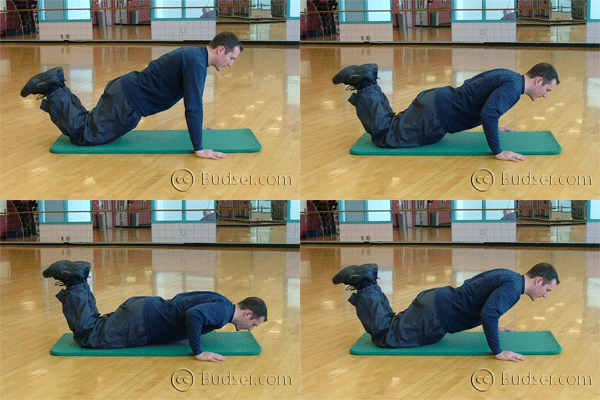
- Progression:Lengthen the resistive force arm by moving your body’s fulcrum
( Knee Push-Up → Push-Up)
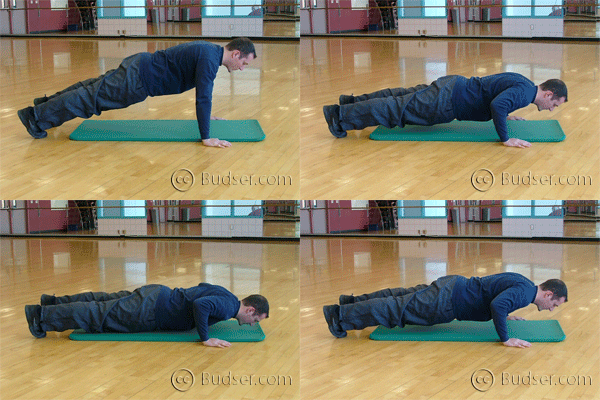
- Progression:Lengthen the resistive force arm by increasing your body’s pitch
( Push-Up → Progressed Push-Up)

Pendulums
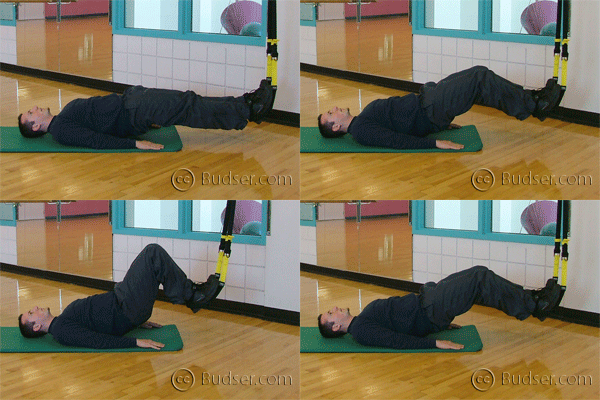
- Progression: start further away from the anchor point to change gravity’s force vector
( TRX Hamstring Curl → TRX Hamstring Curl farther from anchor point)

(2) Weight Allocation
- Regression: Self-Assisted Exercise 1 ( Squat → Row Squat )

- Regression: Self-Assisted Exercise 2
( Pull-up with Crunch → Assisted Pull-up )

- Progression: Isolateral loading
( Progressed Push-Up → Advanced Push-Up)
- Progression: Biceps Curl
(Two Arm → Single Arm)

- Progression: Squat
Narrow Squat → Single-leg Squat
Single Leg Squat with step (Weight centered over front leg, approximately parallel shin and trunk)


(3) Acceleration
- Progression: Increase acceleration to produce forces that are many multiples of your static weight!
Reverse Lunge: Force = Mass*9.8m/s/s → Plyometric Lunge: Force = Mass*(9.8m/s/s + Chosen Acceleration)


(4) Balance (Vestibular System)
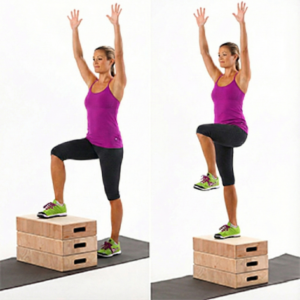
- Progression: (Assisted Step-up → Unassisted Step-up)

Options for progression:
(1) The base of support is changed from wide (hands and feet) to narrow (just feet)
(2) The height of the body’s center of mass is increased by lifting one knee to hip height or by lifting arms overhead
(3) The range of motion (ROM) at the knee and hip is increased from 45° in the first to 90° by choosing a higher step, increasing demand on stabilizer muscles and joint mobility.

(5) Complexity
- Single Joint → Multi-Joint: Hip Extension → Bird Dog

Load this page on your device:


